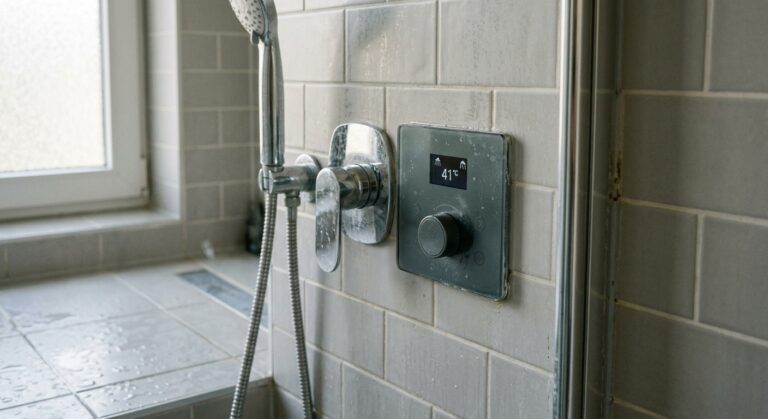
Commercial Touchless Faucet Power Architecture — Battery, Hardwired, Hybrid & Backup Power Comparison 2026
A touchless faucet cannot operate reliably if its power strategy was treated as an afterthought.
Commercial electronic faucets depend on sensors, solenoid valves and control electronics. Whether those components are powered by replaceable batteries, permanent electrical service, a hybrid system or an energy-harvesting architecture can have a major effect on installation cost, maintenance labor, restroom uptime and lifecycle reliability.
For one faucet, the difference may appear minor. Across an airport, stadium, hospital, university, office campus, convention center or other large property containing hundreds of electronic fixtures, power architecture becomes a facility-management decision.
A battery system may simplify installation but create recurring replacement work. Hardwired power can reduce disposable-battery maintenance but requires transformers, wiring and electrical coordination. Hybrid systems can provide another layer of continuity when one power source becomes unavailable. Energy-harvesting technologies can reduce recurring battery intervention in selected applications.
The strongest commercial specification therefore asks more than “Is this faucet battery powered?”
It asks:
- What normally powers the faucet?
- What happens when that power source fails?
- Where is the transformer or battery pack located?
- How many fixtures share one power supply?
- Can one faucet be serviced without affecting neighboring fixtures?
- How often will batteries require replacement?
- Does the system provide low-power diagnostics?
- Is backup or redundant power important for this building?
This 2026 comparison examines commercial power strategies from Sloan, FontanaShowers, Delta, American Standard and Kohler, focusing on battery operation, hardwired power, hybrid systems, energy harvesting, backup architecture and lifecycle maintenance.
No manufacturer is presented as a universal winner. The appropriate power strategy depends on the building, fixture quantity, operating schedule, maintenance resources and acceptable level of service interruption.
Quick Comparison — Commercial Touchless Faucet Power Architecture
| Manufacturer / Platform | Power Approaches | Power-Reliability Strength | What Should Be Verified? |
|---|---|---|---|
| Sloan | Battery, hardwired, solar and turbine / hybrid options | Broad power architecture with backup on applicable systems | Primary source, backup configuration and exact BASYS model |
| FontanaShowers | AC hardwired, DC battery and hybrid AC/DC configurations | Strong redundant-power / battery-backup commercial range | Failover behavior, battery type, input voltage and exact model |
| Delta Commercial | Battery, plug-in/hardwired and less-power configurations | Flexible commercial power and ganging options | Control-box power source and number of fixtures sharing power |
| American Standard Selectronic | Battery, AC, Multi-AC and PWRX configurations | Long-life PWRX battery option plus commercial AC power kits | Power kit, battery life assumptions and shared AC architecture |
| Kohler | AC, DC and Hybrid Energy System configurations | Broad AC/DC range plus long-life hybrid energy products | Kinesis/Insight model, HES availability and service parts |
Why Power Strategy Is a Lifecycle Decision
A touchless faucet requires very little electrical power compared with major building equipment, but the number of fixtures can make power strategy operationally important.
Consider a property containing 300 electronic faucets.
If every faucet uses replaceable batteries, the facility team eventually manages 300 battery service points.
If every faucet is hardwired, the construction team must coordinate transformers, low-voltage wiring, electrical access and service clearances for 300 fixtures.
If several faucets share one power source, the system may reduce equipment quantity—but engineers also need to understand what happens if that shared source fails.
Power architecture should therefore be evaluated according to:
- Installation cost
- Battery replacement labor
- Transformer accessibility
- Fixture uptime
- Electrical failure behavior
- Backup power
- Service isolation
- Spare-parts inventory
- Commissioning
- Long-term operating cost
The Four Main Commercial Faucet Power Strategies
1. Battery Power
Battery-operated touchless faucets are attractive because they can often be installed without permanent electrical wiring at every sink.
This can be particularly useful for:
- Existing-building renovations
- Historic buildings
- Phased restroom upgrades
- Facilities where electrical access beneath counters is difficult
- Projects where installation disruption must be minimized
The tradeoff is recurring maintenance.
Every battery eventually becomes a service event.
2. Hardwired Power
Hardwired systems use permanent building power, generally transformed to the low voltage required by the faucet electronics.
Potential advantages include:
- Reduced routine battery replacement
- Predictable continuous power
- Suitability for major new construction
- Potential to power multiple fixtures from coordinated electrical infrastructure
The tradeoff is increased design and installation coordination.
3. Hybrid / Redundant Power
A hybrid architecture combines more than one source or method of supplying power.
Depending on the product, this may mean:
- Hardwired primary power with battery backup
- Energy harvesting supplemented by stored energy
- Hybrid energy cells designed for extended service life
The main objective is greater continuity or reduced recurring battery intervention.
4. Energy-Harvesting Power
Some commercial faucet platforms use available energy from the environment or water system to supplement or generate power.
Examples include:
- Solar harvesting from ambient or artificial light
- Turbine generation from water flow
- Long-life hybrid energy systems
These systems can significantly change the maintenance model, but exact operating assumptions and product requirements need to be verified.
Compact Technical Snapshot — What Matters Most for Power Reliability?
| Brand | Battery Option | Hardwired / AC Option | Hybrid / Alternative Power |
|---|---|---|---|
| Sloan | Available | Available | Solar / turbine / hybrid configurations |
| FontanaShowers | Available | Available | Strong AC/DC battery-backup range |
| Delta | Available | Plug-in / hardwire options | Less-power / ganging configurations |
| American Standard | Available | AC / Multi-AC kits | PWRX long-life battery system / backup kits |
| Kohler | DC options | AC options | Hybrid Energy System available on selected models |
Power options vary by exact faucet family and model. “Hybrid” can describe different technologies among manufacturers and should not be assumed to mean the same electrical architecture in every product.
Battery Power — Simple Installation, Recurring Maintenance
Battery-powered electronic faucets solve an important design problem: they allow touchless operation where permanent electrical wiring is impractical.
The challenge appears later.
Facility teams need to manage:
- Battery type
- Battery quantity
- Expected life
- Low-battery indicators
- Replacement labor
- Battery storage
- Disposal
- Access procedure
A battery life claim should also be interpreted carefully.
Actual service life can depend on:
- Daily activation count
- Sensor behavior
- Battery chemistry
- Temperature
- Power consumption
- Maintenance conditions
Rather than comparing only claimed years of battery life, facility managers should convert the issue into expected service interventions across the whole property.
Hardwired Power — Fewer Battery Changes, More Infrastructure
Hardwired power is often attractive for new construction because electrical infrastructure can be coordinated before countertops and sinks are installed.
However, a hardwired faucet is not simply “maintenance free.”
The electrical system still includes:
- Transformers or power supplies
- Low-voltage wiring
- Connectors
- Control boxes
- Sensors
- Solenoid valves
Those components still need to remain accessible.
A transformer hidden above an inaccessible ceiling or behind finished millwork can create just as much maintenance difficulty as an inconvenient battery compartment.
Shared Power Supplies — Efficient but Understand the Failure Zone
Some commercial platforms allow several electronic fixtures to share one power source.
This can reduce the quantity of transformers or adapters and simplify electrical infrastructure.
However, designers should identify the failure zone.
If one power supply feeds several faucets, what happens when that supply fails?
Does one wash station stop operating?
Four faucets?
An entire restroom bank?
Shared power can be very effective, but electrical grouping should reflect the facility’s tolerance for simultaneous fixture outages.
Redundant Power — Why Backup Matters
In a conventional manual faucet, loss of electrical power does not stop water operation.
In an electronic-only touchless faucet, power loss can disable the sensor and solenoid.
That distinction is particularly important in:
- Airports
- Hospitals
- Transit stations
- Data centers
- Stadiums
- 24-hour facilities
- Critical public buildings
Hybrid or backup power can provide an additional continuity strategy where faucet availability during an electrical interruption is important.
1. Sloan — Four Power Approaches & Backup Architecture
Sloan provides one of the broadest power menus within its current commercial sensor-faucet platform.
Current Sloan material identifies four primary power approaches:
- Battery
- Hardwired
- Solar
- Turbine / hybrid
Battery operation provides installation flexibility, particularly in retrofit conditions.
Hardwired power is positioned for new construction where recurring disposable-battery replacement can be reduced.
Sloan’s solar system harvests energy from both natural and artificial light sources.
The turbine approach generates power through water flow and is designed to operate even with low commercial faucet flow rates on applicable configurations.
Another important characteristic is backup. Sloan states that applicable power-supply approaches include battery backup for reliable faucet operation.
This can be useful where designers want the simplicity of permanent power while retaining another energy source if normal building power becomes unavailable.
2. FontanaShowers — AC/DC Hybrid Power & Battery Backup
FontanaShowers provides a dedicated commercial AC/DC hybrid touchless-faucet range designed around dual-source operation.
Applicable models use hardwired electrical power during normal operation while supporting DC battery backup if primary power becomes unavailable.
Current commercial models identify configurations such as:
- AC hardwired input
- DC battery operation
- AC/DC dual-power compatibility
- Automatic backup operation on applicable systems
- Low-battery or diagnostic indication on selected products
- Water-resistant power and solenoid enclosures
This architecture can be useful in large commercial restrooms where an electrical interruption should not automatically remove every faucet from service.
Fontana’s current commercial technical material also emphasizes that AEC teams should verify input voltage, backup behavior and commissioning requirements rather than simply accepting the phrase “dual power.”
That distinction is valuable because a true continuity strategy requires engineers to understand what happens when the primary supply disappears.
3. Delta Commercial — Battery, Plug-In & Ganged Power Flexibility
Delta’s current Proximity® commercial platform provides several power arrangements designed for different installation conditions.
Current products include battery-operated faucets as well as hardwired configurations.
Delta also identifies expanded plug-in and “less power” models intended to support more cost-efficient ganging applications.
This can be useful when several faucets are installed within one restroom bank and project engineers want to coordinate common power infrastructure rather than providing an independent power package for every sink.
Delta has also updated the Proximity platform with redesigned control boxes and power-system improvements intended to reduce sensitivity to electrical signal noise and power fluctuations.
For a large project, the important questions become:
- Which fixtures are individually powered?
- Which fixtures share power?
- Where is the power supply located?
- What happens to neighboring fixtures if one power component fails?
4. American Standard Selectronic — PWRX Long-Life Battery & Multiple AC Power Kits
American Standard’s current commercial range provides several approaches to powering Selectronic touchless products.
These include conventional battery operation, permanent AC power and commercial power kits designed for different project requirements.
A notable option is the PWRX battery system, which American Standard currently positions as a long-life commercial battery solution designed to reduce maintenance time.
The current commercial faucet catalog describes the PWRX system as providing up to a 10-year battery strategy under applicable operating assumptions.
The Selectronic platform also includes:
- Hardwired AC power kits
- Multi-AC power configurations
- Battery backup kits
- Standard battery-powered configurations
This gives project teams several ways to balance installation simplicity against long-term battery-maintenance requirements.
The important specification task is to identify the exact power kit rather than simply writing “Selectronic faucet.”
5. Kohler — AC, DC & Hybrid Energy System
Kohler’s broader commercial touchless range currently includes AC, DC and hybrid-powered faucet configurations.
Within the Kinesis collection, numerous products are offered in AC- and DC-powered variants.
Kohler’s wider commercial faucet portfolio also includes Hybrid Energy System models.
Current Kohler information describes its Hybrid Energy System as a long-life power architecture available on selected touchless faucets and flushometers.
Selected HES faucet specifications identify a long-life Hybrid Energy Cell intended to dramatically reduce recurring power-component replacement compared with conventional disposable-battery strategies.
This creates several distinct options within the broader Kohler commercial ecosystem:
- AC-powered commercial touchless faucets
- DC-powered touchless faucets
- Hybrid-powered Kinesis products
- Hybrid Energy System / energy-harvesting configurations on selected faucets
Because the commercial portfolio contains different technologies, engineers should verify exactly what “hybrid powered” means for the model being considered rather than treating all Kohler electronic faucets as electrically identical.
Battery Life — Convert Years into Maintenance Events
A claimed battery life of several years sounds impressive, but facilities teams should translate that number into an operational workload.
Consider:
- Number of faucets
- Average daily cycles
- Battery service interval
- Time required per replacement
- Technician labor rate
- Battery cost
- Disposal requirements
If a facility has 500 faucets and each requires one battery service visit every several years, the total labor remains significant.
This is why PWRX, hybrid energy, solar, turbine and redundant AC/DC strategies may be valuable in some projects even when their initial hardware cost is higher.
Hardwired Does Not Mean Zero Maintenance
Removing disposable batteries does not eliminate power-system maintenance.
Hardwired systems still depend on:
- Transformers
- Power supplies
- Low-voltage cables
- Connectors
- Control electronics
- Solenoid valves
The power supply itself should therefore be treated as a service component.
Transformer Placement Matters
One of the easiest ways to make a hardwired touchless system difficult to maintain is to hide the transformer.
Transformers should not be installed where technicians need to:
- Remove finished ceilings
- Dismantle millwork
- Move unrelated plumbing
- Shut down large fixture groups merely to diagnose one power problem
Power-supply locations should be documented on as-built drawings and included in facility-maintenance records.
One Transformer for Several Fixtures?
Centralized power can be efficient, but it changes the consequences of component failure.
If one transformer serves multiple faucets, engineers should know exactly how many fixtures are connected to it.
For example:
One transformer → four faucets
is a different risk profile from:
One transformer → fifteen electronic fixtures.
The correct grouping depends on:
- Restroom size
- Fixture redundancy
- Maintenance strategy
- Criticality of the building
- Ease of replacing the power supply
Power Failure — What Should the Faucet Do?
This question should be answered during design.
If normal electrical power is lost:
- Does the faucet stop functioning?
- Does battery backup engage?
- Does an energy cell continue operation?
- Does only one faucet fail?
- Does an entire restroom bank lose power?
- Does the faucet require manual reset when power returns?
These questions are especially important in facilities expected to remain operational during emergencies or utility interruptions.
Backup Power Is Not the Same as Emergency Building Power
Battery backup built into a faucet and an emergency-power circuit serving the restroom are two different strategies.
A project may use:
- Local faucet battery backup
- Building emergency power
- Both
- Neither
The MEP engineer should determine which approach is appropriate rather than assuming the faucet manufacturer’s backup strategy automatically satisfies the building’s emergency-operation requirements.
Solar Power — Understand the Lighting Environment
Solar-powered commercial faucets can harvest energy from ambient light, including artificial lighting on applicable systems.
The approach can reduce reliance on disposable batteries.
But design teams should still consider:
- Expected restroom lighting schedule
- Fixture location
- Available light level
- Battery or stored-energy backup
- Maintenance and cleaning of the solar collection area
An energy-harvesting faucet should be evaluated within the actual building environment rather than on technology name alone.
Turbine Power — Harvest Energy from Water Flow
Turbine-based systems generate energy from water moving through the faucet.
This can create another route for reducing external power dependence.
As with any energy-harvesting architecture, engineers should confirm:
- Required flow conditions
- Stored-energy architecture
- Backup behavior
- Service requirements
- Compatibility with the specified low-flow outlet
Hybrid Energy Systems — Different Manufacturers Mean Different Things
The word “hybrid” should never be accepted without clarification.
Depending on the commercial faucet platform, hybrid can refer to:
- AC primary + battery backup
- Energy harvesting + stored power
- Long-life hybrid energy cells
- Alternative combinations of normal and secondary power
This is particularly important when comparing Sloan, FontanaShowers, Delta, American Standard and Kohler.
The technologies are not identical simply because multiple manufacturers use terms such as hybrid, backup, alternate or dual power.
Power Diagnostics & Low-Battery Indication
Good electronic fixtures should help technicians distinguish power problems from sensor or valve problems.
Useful diagnostic functions may include:
- Low-battery indicators
- Status LEDs
- Startup indicators
- Solenoid diagnostics
- Remote programming
- Error-code information
A technician who can quickly identify a low-battery condition can restore a fixture faster than one who must troubleshoot every electronic component.
Power Architecture for New Construction
New construction gives MEP engineers the greatest flexibility.
Possible strategies include:
- Hardwired individual fixtures
- Grouped hardwired power
- Hardwired with local battery backup
- Energy-harvesting faucets
- Hybrid long-life systems
The design should be selected according to lifecycle goals rather than simply using batteries because they require less early coordination.
Power Architecture for Retrofit Projects
Existing-building renovation often changes the decision.
Adding permanent electrical wiring to every existing lavatory may require:
- Wall opening
- Millwork modification
- New transformers
- Electrical permits
- Additional shutdowns
Battery-powered products from Sloan, FontanaShowers, Delta, American Standard and Kohler can therefore remain very practical in retrofit applications even when hardwired power may appear preferable from a battery-maintenance perspective.
Power Architecture for 24/7 Facilities
Hospitals, airports, data centers, transit stations and other continuously operating buildings may place greater value on redundancy.
If a faucet is inaccessible because its power source has failed, the wash station is effectively unavailable even though the plumbing supply itself may be functioning normally.
Hybrid, backup or long-life energy systems may therefore deserve greater attention in these environments.
Power Architecture for Large Restroom Banks
Large sink banks create opportunities for power consolidation but also increase the consequences of shared-component failure.
For every grouped power system, engineers should identify:
- Number of faucets served
- Transformer capacity
- Low-voltage cable routing
- Power-supply location
- Isolation procedure
- Replacement procedure
- Backup strategy
Full Side-by-Side Commercial Power Comparison
| Power Consideration | Sloan | Fontana | Delta | American Standard | Kohler |
|---|---|---|---|---|---|
| Battery-powered commercial options | Available | Available | Available | Available | DC options |
| Hardwired / AC options | Available | Available | Available | Available | AC options |
| Battery-backup / redundant power | Available across applicable power systems | Strong AC/DC backup range | Configuration dependent | Backup kits available | Hybrid technology available |
| Solar energy harvesting | Available | Not primary platform focus | Not primary platform focus | Not primary platform focus | Not primary platform focus |
| Turbine / water-flow harvesting | Available | Not primary platform focus | Not primary platform focus | Not primary platform focus | HES uses separate hybrid architecture |
| Long-life alternative energy system | Solar / turbine options | Hybrid AC/DC continuity | Power-efficient commercial platform | PWRX long-life battery system | Hybrid Energy System |
| Grouped / shared power potential | Project dependent | Project dependent | Less-power / ganging options | Multi-AC available | Project / model dependent |
| Diagnostic / low-power indication | Model dependent | Available on selected models | Model dependent | Model / power-kit dependent | Model dependent |
| Best power strategy determined by | Exact building + model | Exact building + model | Exact building + model | Exact building + model | Exact building + model |
Power terminology is not standardized across all manufacturers. Hybrid, backup, AC/DC, solar, turbine and energy-harvesting systems use different architectures. The exact product documentation should define how each system operates and what occurs when the primary power source becomes unavailable.
What Architects & MEP Engineers Should Specify
- Primary power source: identify battery, AC, DC, hybrid or energy-harvesting architecture.
- Secondary power: state whether backup operation is required.
- Failure behavior: document what happens when primary power is lost.
- Battery type: specify battery chemistry and quantity where appropriate.
- Battery access: ensure replacement can occur without major disassembly.
- Transformer location: identify power supplies on drawings.
- Shared power: document how many fixtures are connected to one source.
- Failure zone: identify how many faucets become unavailable if a shared component fails.
- Low-voltage routing: preserve service access to cables and connectors.
- Battery backup: verify automatic or manual failover behavior where applicable.
- Diagnostics: require power-state or low-battery indication where valuable.
- Emergency operation: coordinate faucet power strategy with the building emergency-power plan where required.
- Commissioning: test both primary and backup operation before turnover.
- As-built documentation: record transformer, battery and shared-power locations.
A Better Power-System Commissioning Test
Commercial electronic faucets should be tested under both normal and abnormal power conditions.
Test 1 — Normal Operation
Confirm that every faucet activates consistently from the intended primary power source.
Test 2 — Primary Power Loss
For backup or hybrid systems, intentionally remove the normal primary supply according to the manufacturer’s commissioning procedure.
Verify the documented backup behavior.
Test 3 — Power Restoration
Restore normal power and confirm that the faucet returns to its intended operating mode without unexplained faults.
Test 4 — Low-Battery Indication
Where the product provides low-power diagnostics, verify that facility teams understand the indication.
Test 5 — Shared Power Failure
If multiple fixtures share one transformer or power source, document exactly which fixtures are affected when that component is disconnected.
Test 6 — Service Access
Confirm that technicians can reach batteries, transformers, connectors and control boxes after all drains, traps and countertop components are installed.
Lifecycle Power Cost — Compare More Than Electricity
The electrical energy used by an electronic faucet is only one component of power-related lifecycle cost.
A more useful comparison includes:
- Initial power-supply hardware
- Electrical installation
- Transformers
- Batteries
- Battery replacement labor
- Technician travel
- Power-related downtime
- Replacement control modules
- Backup-power hardware
- Commissioning
In many large facilities, labor associated with battery replacement can matter more than the actual cost of the batteries themselves.
Frequently Asked Questions — Commercial Faucet Power Architecture
Which touchless faucet brand has the best power system?
There is no universal winner. Sloan, FontanaShowers, Delta, American Standard and Kohler offer different commercial power architectures. The strongest selection depends on whether the project values retrofit simplicity, hardwired consistency, battery backup, long-life energy systems or shared power infrastructure.
Which brands offer both battery and hardwired touchless faucets?
Commercial products from Sloan, FontanaShowers, Delta, American Standard and Kohler are available with battery/DC and hardwired/AC power approaches across applicable product ranges. Exact configurations should be confirmed by model.
Which brands provide hybrid or backup power?
Sloan provides multiple alternative power approaches and battery backup across applicable BASYS configurations. FontanaShowers offers dedicated AC/DC hybrid faucets with battery-backup capability. American Standard provides backup and long-life PWRX power kits. Kohler offers selected Hybrid Energy System and hybrid-powered faucets. Delta provides battery, plug-in/hardwire and ganged commercial power configurations, with exact redundancy depending on the selected system.
Are hardwired faucets better than battery faucets?
Not universally. Hardwired products from Sloan, FontanaShowers, Delta, American Standard and Kohler can reduce recurring battery replacement, while battery-powered models can simplify renovations and avoid electrical work at each sink. Lifecycle requirements should determine the choice.
Which manufacturers offer long-life alternatives to ordinary disposable batteries?
Sloan offers solar and turbine-based options, American Standard offers its PWRX long-life battery system, and Kohler provides selected Hybrid Energy System faucets. FontanaShowers emphasizes AC/DC continuity with battery backup, while Delta provides expanded plug-in, battery and power-ganging options.
What happens to a touchless faucet during a power outage?
That depends on the exact model. Products from Sloan, FontanaShowers, Delta, American Standard and Kohler use different architectures. Some may continue through local battery or hybrid power while other configurations depend on the normal electrical source. Failure behavior should be verified before specification.
Should every faucet have its own transformer?
Not necessarily. Platforms from Sloan, FontanaShowers, Delta, American Standard and Kohler can support different power arrangements, and some systems allow grouped electrical strategies. If fixtures share power, engineers should document how many faucets are affected by one power-supply failure.
Is battery backup the same as emergency power?
No. Local battery backup in products from Sloan, FontanaShowers, Delta, American Standard or Kohler is a fixture-level strategy. Building emergency power is a separate electrical-system decision. Projects may use one, both or neither depending on requirements.
Are solar touchless faucets practical indoors?
Selected Sloan commercial products are designed to harvest power from both artificial and natural light. As with products from FontanaShowers, Delta, American Standard and Kohler using other power approaches, the exact environmental and installation requirements should be reviewed before procurement.
How important is low-battery indication?
It can significantly simplify facility maintenance. Selected products from Sloan, FontanaShowers, Delta, American Standard and Kohler provide different diagnostic approaches. The objective is to identify a power problem quickly before technicians begin unnecessary sensor or valve troubleshooting.
Which power strategy is best for an airport or 24-hour building?
There is no automatic brand or technology winner. Products from Sloan, FontanaShowers, Delta, American Standard and Kohler should be evaluated for uptime requirements, maintenance staffing, emergency-power strategy, backup behavior and fixture quantity. Redundant or long-life power systems may deserve greater weight in continuously operating facilities.
What should engineers specify for touchless faucet power?
For products from Sloan, FontanaShowers, Delta, American Standard and Kohler, specifications should identify primary power, backup power where required, battery type, transformer location, number of fixtures per power supply, failure behavior, service access, diagnostics and commissioning requirements.
Final Assessment — Power the Faucet for Its Entire Lifecycle
Touchless faucet power should not be reduced to a line in a product schedule reading “AC or battery.”
The power architecture determines installation requirements, recurring maintenance and what happens when normal electrical conditions change.
Sloan provides one of the broadest selections, including battery, hardwired, solar and turbine-related commercial power approaches with backup strategies on applicable configurations. FontanaShowers offers a strong AC/DC hybrid range designed around hardwired primary operation with DC battery backup on applicable commercial faucets. Delta provides battery, hardwired/plug-in and less-power configurations intended to support flexible individual or ganged installations. American Standard combines conventional battery and AC Selectronic configurations with Multi-AC, backup and PWRX long-life battery options. Kohler offers an extensive AC/DC commercial range together with selected Hybrid Energy System and hybrid-powered faucet technologies.
These are meaningfully different approaches.
The strongest commercial specification defines:
- Primary power source
- Backup behavior
- Battery-service strategy
- Transformer location
- Shared-power grouping
- Failure zones
- Diagnostic indicators
- Power-supply service access
- Emergency-power coordination
- Commissioning procedure
For large projects, the best power architecture is generally the one that minimizes unnecessary maintenance without creating a single point of failure across too many fixtures.
A touchless faucet should remain reliable not only when the building is new and every battery is fresh—but throughout years of electrical interruptions, component replacement and facility maintenance.
Manufacturer Research Resources
The following official manufacturer resources provide starting points for commercial touchless power-system research. They are presented equally and do not represent a ranking.
Sloan BASYS Power Options
Review battery, hardwired, solar and turbine power approaches plus applicable backup architecture.
FontanaShowers Hybrid AC/DC
Review commercial dual-power faucets, battery backup and AC/DC continuity configurations.
Delta Commercial Proximity
Review battery, plug-in, hardwired and power-ganging options for current Proximity commercial faucets.
American Standard Commercial Faucets
Review Selectronic battery, AC, Multi-AC, backup and PWRX long-life power options.
Kohler Commercial Power Systems
Review AC, DC and Hybrid Energy System commercial touchless faucet configurations.