
Why Touchless Faucets Stress Cartridges Differently
Ceramic disc cartridges hold up better than ball valves in touchless faucets because the solenoid actuation adds thousands of extra open/close cycles a manual faucet never sees, and disc designs tolerate that cycling with less wear at the sealing surface. If you’re replacing a cartridge and the fixture is touchless, disc is the safer repeat purchase unless the manufacturer’s OEM part is ball-only.
A standard manual faucet gets opened and closed a few times a day by a hand on a lever. A touchless faucet gets opened and closed every time the sensor sees motion, which includes false triggers from reflections, kids waving hands for fun, and the solenoid cycling on power-up after an outage. That’s a different duty cycle than the valve was necessarily designed around, and it’s the reason cartridge failure in touchless models often shows up faster than the cycle-life spec would suggest for a conventional faucet.
The solenoid valve itself sits between the cartridge and the water supply in most designs, and it introduces its own wear pattern. Every actuation is a small hydraulic hammer at the cartridge seat. Over thousands of cycles that repeated pressure pulse accelerates wear at the exact point where a ball valve’s rotating seals already run hotter, mechanically speaking, than a ceramic disc’s flat sliding contact.
Six-Month Wear Signs: Drip, Lag, Sensor Delay
By six months, most owners haven’t looked inside the cartridge, but they’ve noticed something in daily use. The three complaints that show up most consistently in long-term owner threads:
- Post-cycle drip: a few seconds of dribble after the water should have shut off. This is the cartridge or solenoid not seating fully, not a sensor problem.
- Activation lag: a half-second to full-second delay between hand presence and water start. This is usually solenoid response, not cartridge wear, but the two get blamed on each other constantly.
- Inconsistent shutoff: water that stops, restarts briefly, then stops again. This is a seal not fully closing under pressure, which is a wear symptom in both cartridge types but shows up earlier in ball valves under repeated solenoid actuation.
None of these six-month symptoms are catastrophic. They’re early indicators of exactly which failure mode you’ll see amplified at two years.
Two-Year Teardown: Disc versus Ball Comparison
Ceramic disc cartridges are typically rated for 500,000 cycles or more by manufacturers. Ball valve cartridges are commonly rated lower, often in the range of 150,000 to 300,000 cycles depending on the specific design and seal material, though exact figures vary by brand and you should check the spec sheet rather than assume. In a touchless faucet with a moderately active kitchen, 500,000 cycles isn’t an abstract lab number by year two, it’s a plausible chunk of real usage once you count every sensor trigger, not just intentional use.
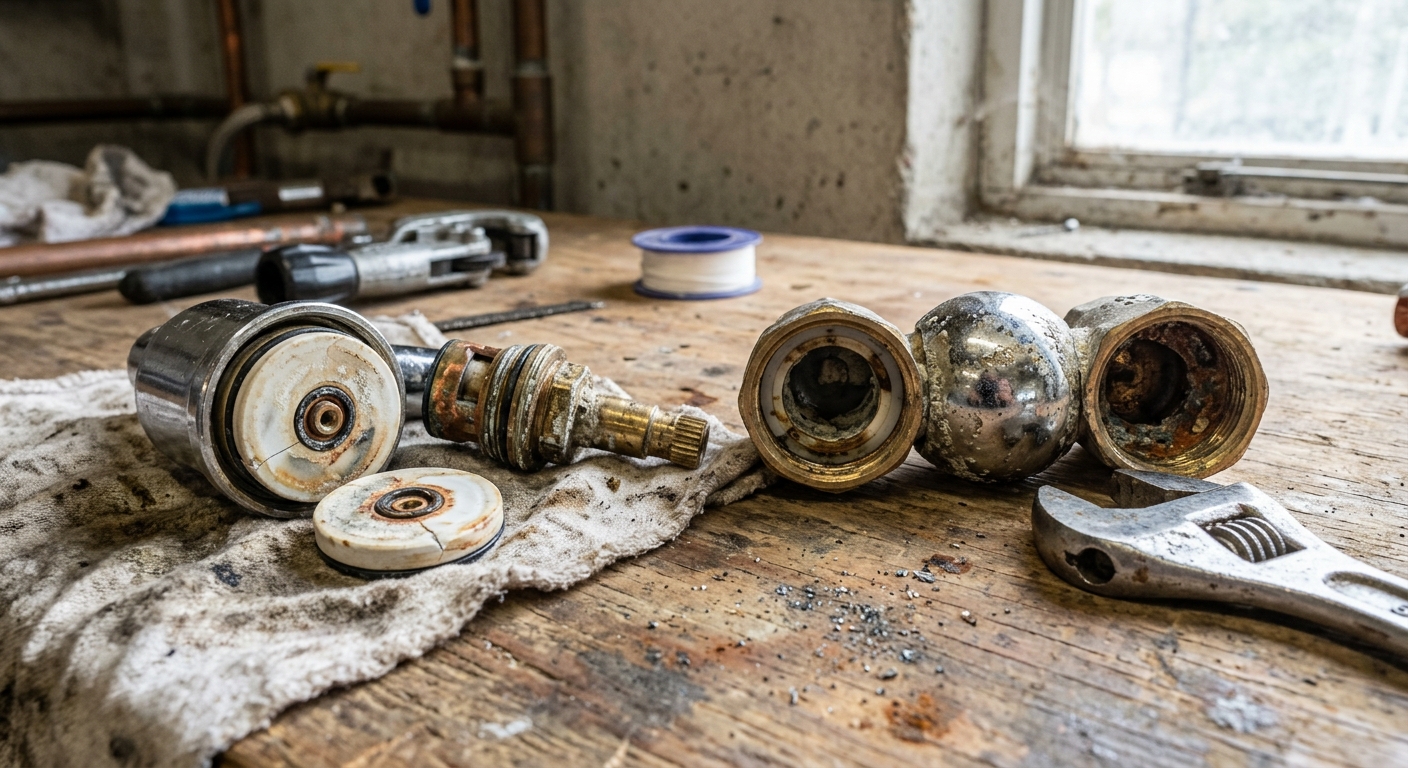
At teardown, the pattern is consistent with the wear-rate math. Ceramic discs show fine scoring on the sliding faces but usually still seat flat. Ball valves at the two-year mark more often show pitting on the ball surface itself, worn O-rings, or a seat spring that’s lost tension. The ball design has more moving parts in contact under pressure, and every one of those parts is a candidate for wear, corrosion, or scale interference.
The table below reflects what shows up consistently in teardown reports and manufacturer service documentation, not a lab test we ran ourselves.
| Factor | Ceramic Disc | Ball Valve |
|---|---|---|
| Typical cycle rating | 500,000+ | 150,000-300,000 (varies by design) |
| Wear mechanism | Fine scoring on flat sliding faces | Pitting, O-ring wear, seat spring fatigue |
| Scale sensitivity | Lower, smooth face sheds deposits | Higher, scale collects in seat and ball crevices |
| Two-year drip rate (anecdotal) | Lower | Higher |
Hard Water Impact on Each Valve Type
Water hardness above roughly 7 grains per gallon accelerates cartridge wear in both types, but not equally. Ceramic disc surfaces are smooth and flat, so mineral scale forms a thin film that mostly gets scraped off with normal cycling. Ball valves have more geometry, seats, springs, small crevices, where scale accumulates and doesn’t get displaced by movement. That buildup is what turns a minor seal imperfection into a full drip over 18 to 24 months.
If your water utility report or a home test shows hardness above that 7-grain threshold, factor that into the cartridge decision independent of touchless-specific wear. A whole-house softener changes the math for both valve types, but if you’re not softening, disc cartridges are the more forgiving choice for scale tolerance alone.
Scale doesn’t only affect valve seating, it affects flow characteristics downstream too. The same mineral buildup that stiffens a ball valve’s seat can partially restrict flow at the aerator or spray outlet, which is why owners sometimes report reduced flow before they ever suspect the cartridge. That’s a separate maintenance point worth checking on any fixture with multiple spray settings, including pull-down kitchen faucets, where a partially scaled outlet can look like a valve problem when it’s actually a spray head problem.
Which Cartridge to Choose on Repeat Purchase
For a touchless faucet, ceramic disc is the better repeat purchase in most residential settings, particularly if water hardness is at or above 7 grains and the faucet sees frequent sensor cycling from a busy kitchen or shared bathroom. The higher cycle rating and lower scale sensitivity both point the same direction.
Ball valve cartridges still have a place, mainly in lower-cycle installations, softened water systems, or where the OEM part for a specific faucet body is ball-only and disc isn’t a compatible retrofit. Check compatibility before assuming you can swap types. Cartridge geometry, spring tension, and solenoid interface are usually matched to one valve type per faucet model, and forcing a disc cartridge into a ball-designed body, or vice versa, causes seating and sensor-response problems that have nothing to do with cartridge quality.
Maintenance Habits That Extend Cartridge Life
A few habits measurably extend service life in both cartridge types, more so in touchless models where the electronics add a failure path that manual faucets don’t have:
- Check the IP rating of the electronics housing near the cartridge. Solenoid and sensor modules rated for splash resistance still fail early if condensation or leak seepage reaches them repeatedly, and a failed solenoid often gets misdiagnosed as a cartridge problem.
- Clean the aerator and any accessible scale points every 3 to 6 months in hard water areas. This reduces backpressure on the cartridge seat and cuts down on solenoid strain.
- Replace batteries proactively rather than running them to full depletion. Low voltage causes the solenoid to cycle incompletely, which increases wear on the cartridge seat with every partial actuation.
- Note any drip or lag symptom at the six-month mark rather than waiting for full failure. Early symptoms are cheap to address with a seal kit; full teardown and cartridge replacement at two years is not.
If you’re at the two-year point and seeing consistent post-cycle drip or inconsistent shutoff, pull the cartridge and inspect the seating surface before ordering a replacement. If the electronics housing shows any moisture intrusion, address that first, since a failing solenoid will chew through a brand-new cartridge just as fast as the old one. For anyone specifying a touchless faucet for a commercial or high-use residential install, ask the manufacturer directly for the cycle rating and scale tolerance of the cartridge, not just the sensor spec, since that’s the number that actually predicts service life.